Showing posts with label Data integration. Show all posts

The Origin of business intelligence:


This post discusses about the origin of business intelligence technique The origins of business intelligence may be traced back to the first data processing applications, which were simple applications such as accounts payable and receivable. These applications ran on sequential technology, such as magnetic and paper tapes.
Using sequential media for storage meant the entire file had to be accessed, even if only
a fraction of the file was needed. Oxide often stripped off of magnetic tapes, and entire
files were lost. These issues led to the need for a new way to analyze information.

Early Data Processing Applications:

With sequential storage, data was organized onto what was called a master file, which held central information that was useful to many applications. Punch cards, magnetic tapes, and reports were generated from the applications, but were soon replaced by disk storage. With disk storage, data could be accessed directly and efficiently. Processors grew more powerful and versatile, and the speed and costs of processing dropped dramatically. As data was stored onto disk, master files mutated into databases. This techniques are used in data ware housing models. Here i would like to give a short information about data warehousing techniques.

Since the beginning of movement toward data warehousing, data warehouses have

been defined as being:

Subject-oriented. Data is organized around a major object or process of an organization. Classic examples include subject area databases for customer, material, vendor, and transaction.

Integrated. The data from various subject areas should be rationalized with one another.

Nonvolatile. Data in a data warehouse is not updated. Once a record is properly

placed in the warehouse, it is not subject to change.


Data management for Business Intelligent system:

Data integration is a one of the salient feature of data ware housing. From this article we know about How data profiling and analysis saves companies $ Millions. Taking charge of organizational data to create a faster, smarter more competitive enterprise by improving data Quality, cutting integration costs and improving the returns from data warehousing initiatives, ERP, CRM, SCM and Business Intelligence.

If senior executives can recognize the value of data, then they can give support to information managers to take control of data. The place for information managers to start is by seeking to better understand the organization’s data: its content, location, structure, quality and suitability for integration with other data in information management projects.

Automated data profiling and analysis solutions have recently made understanding and managing data much more accessible. Data analysts, information managers and senior executives can now take control of data as an asset and work together to maximize returns from across all data-dependent systems—from Customer Relationship Management (CRM) and Supply Chain Management (SCM) to Data Warehousing, Enterprise Resource Planning (ERP) and Business Intelligence (BI).

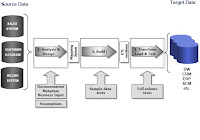
The steps involved in data integration:

The impact of poor data quality on data integration projects:

Until quite recently, few organizations had any information quality function or team charged with the responsibility of ensuring data quality across the enterprise in a strategic or holistic fashion. Data quality was seen as a specific tactical element of implementing a new application, or worse, not even considered at all.

Courtesy: Trillium Software, a division of Harte-Hanks

“In our CRM project, data integration was a secondary consideration for us. We didn’t accurately estimate the time it would take us to integrate the data until it was too late.”

Project manager, major international bank

Ford Financial Europe sought to integrate business intelligence information with a US-based Enterprise Data Warehouse.

Data integration is important for every business model: A structural analysis:

Data integration is a one of the salient feature of data ware housing. From this article we know about How data profiling and analysis saves companies $ Millions. Taking charge of organizational data to create a faster, smarter more competitive enterprise by improving data Quality, cutting integration costs and improving the returns from data warehousing initiatives, ERP, CRM, SCM and Business Intelligence.

If senior executives can recognize the value of data, then they can give support to information managers to take control of data. The place for information managers to start is by seeking to better understand the organization’s data: its content, location, structure, quality and suitability for integration with other data in information management projects.

Automated data profiling and analysis solutions have recently made understanding and managing data much more accessible. Data analysts, information managers and senior executives can now take control of data as an asset and work together to maximize returns from across all data-dependent systems—from Customer Relationship Management (CRM) and Supply Chain Management (SCM) to Data Warehousing, Enterprise Resource Planning (ERP) and Business Intelligence (BI).

The steps involved in data integration:

The impact of poor data quality on data integration projects:

Until quite recently, few organizations had any information quality function or team charged with the responsibility of ensuring data quality across the enterprise in a strategic or holistic fashion. Data quality was seen as a specific tactical element of implementing a new application, or worse, not even considered at all.

Courtesy: Trillium Software, a division of Harte-Hanks

“In our CRM project, data integration was a secondary consideration for us. We didn’t accurately estimate the time it would take us to integrate the data until it was too late.”

Project manager, major international bank

Ford Financial Europe sought to integrate business intelligence information with a US-based Enterprise Data Warehouse.

Angel Investors